Can a Deviated Septum Make Sleep Apnea Worse?
What to do next, based on your situation
Whether you haven't been tested yet or your current treatment isn't giving you full relief, here's the short version: a deviated septum can make things worse, but it's rarely the root cause of sleep apnea by itself.
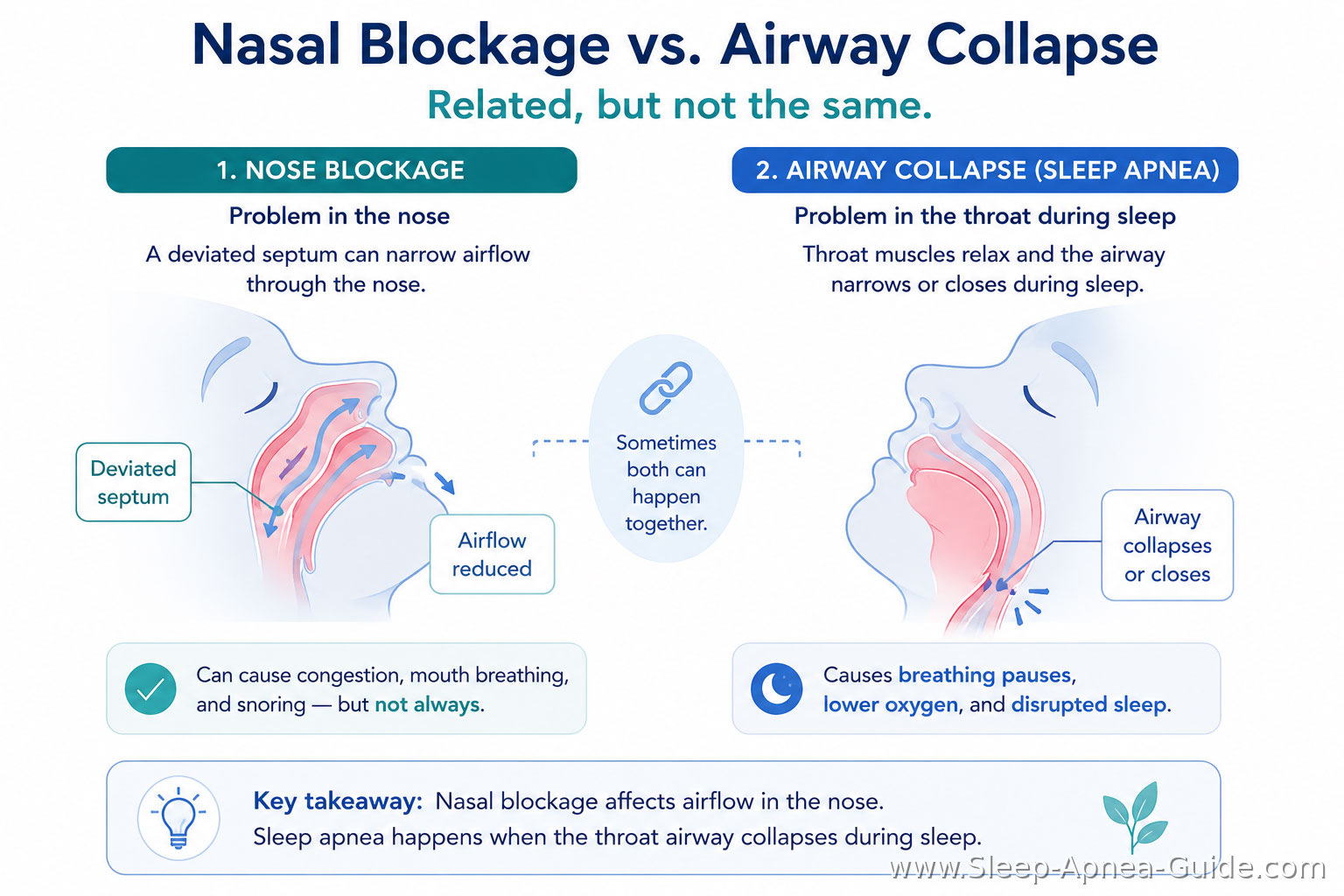
A deviated septum is a structural nasal problem that can reduce airflow on one or both sides of the nose — but obstructive sleep apnea is diagnosed as repeated upper-airway blockage during sleep, and sleep testing is the step that confirms it. Nasal symptoms alone don't diagnose it. [1][2][3]
Sources:
[1] National Institute on Deafness and
Other Communication Disorders (NIDCD). Deviated Septum.
https://www.nidcd.nih.gov/health/deviated-septum
[2] National Heart, Lung, and Blood Institute (NHLBI). Sleep Apnea. https://www.nhlbi.nih.gov/health/sleep-apnea
[3] MedlinePlus. Sleep Apnea. https://medlineplus.gov/sleepapnea.html
Start here, based on what fits today — sleep testing if you haven’t been diagnosed yet, ENT evaluation if your nose feels blocked, CPAP troubleshooting if you're on CPAP and the mask or pressure is the problem, or a nasal surgery (septoplasty) discussion if you're considering surgery.
This guide is based on established guidelines and research from sleep medicine and ENT sources. It's here to help you figure out your next step — testing, an ENT visit, CPAP troubleshooting, or a septoplasty discussion — not to diagnose you or replace your clinician.
Feeling Frustrated With Your Treatment?
You are not alone
If you're feeling treatment-fatigued, frustrated, or worn down by trial and error, you're not the only one — and struggling with treatment does not mean failure. Maybe it's the night you wake up mid-sleep, gasping for air in the dark, heart still pounding, before you can settle back down. More than one issue can be true at the same time, and that doesn't mean you're failing — it just means there's more than one thread to follow.
To find clarity, it helps to separate the cause of your sleep issues from the contributors and the treatment impacts. A deviated septum is better framed as a contributor to nasal blockage and sleep apnea treatment barriers than as the usual direct cause of obstructive sleep apnea. It might be making your snoring worse, or it might be the reason a nasal mask feels impossible to wear.
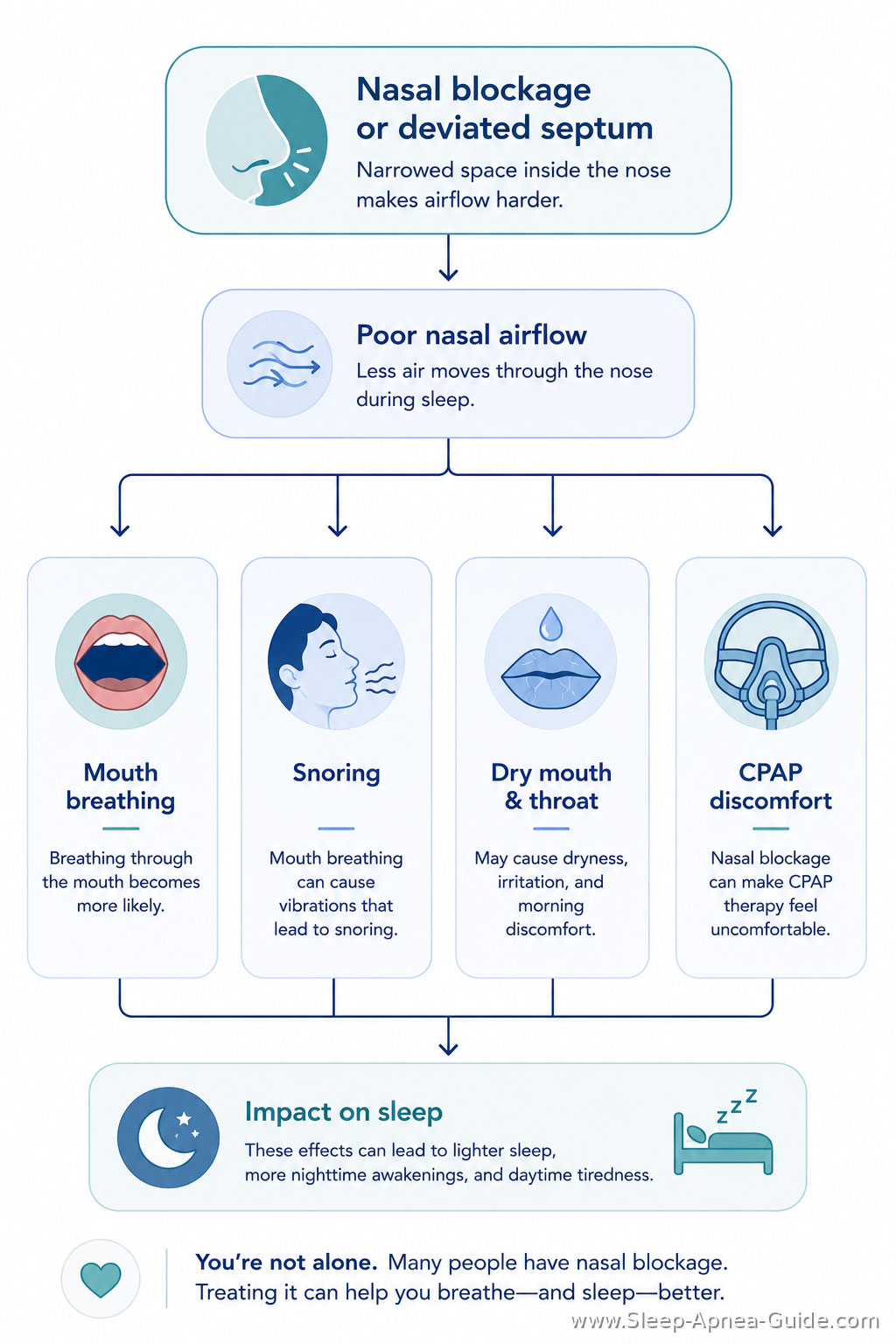
Nasal blockage symptoms and sleep apnea symptoms overlap — snoring, restless sleep, and mouth breathing can occur with either — so the presence of one doesn't rule out the other. [1][2]
Sources:
[1] National Institute on Deafness and Other Communication Disorders
(NIDCD). Deviated Septum.
https://www.nidcd.nih.gov/health/deviated-septum
[2] National Heart, Lung, and Blood Institute (NHLBI). Sleep Apnea. https://www.nhlbi.nih.gov/health/sleep-apnea
Choose Your Next Step: 4 Pathways to Relief
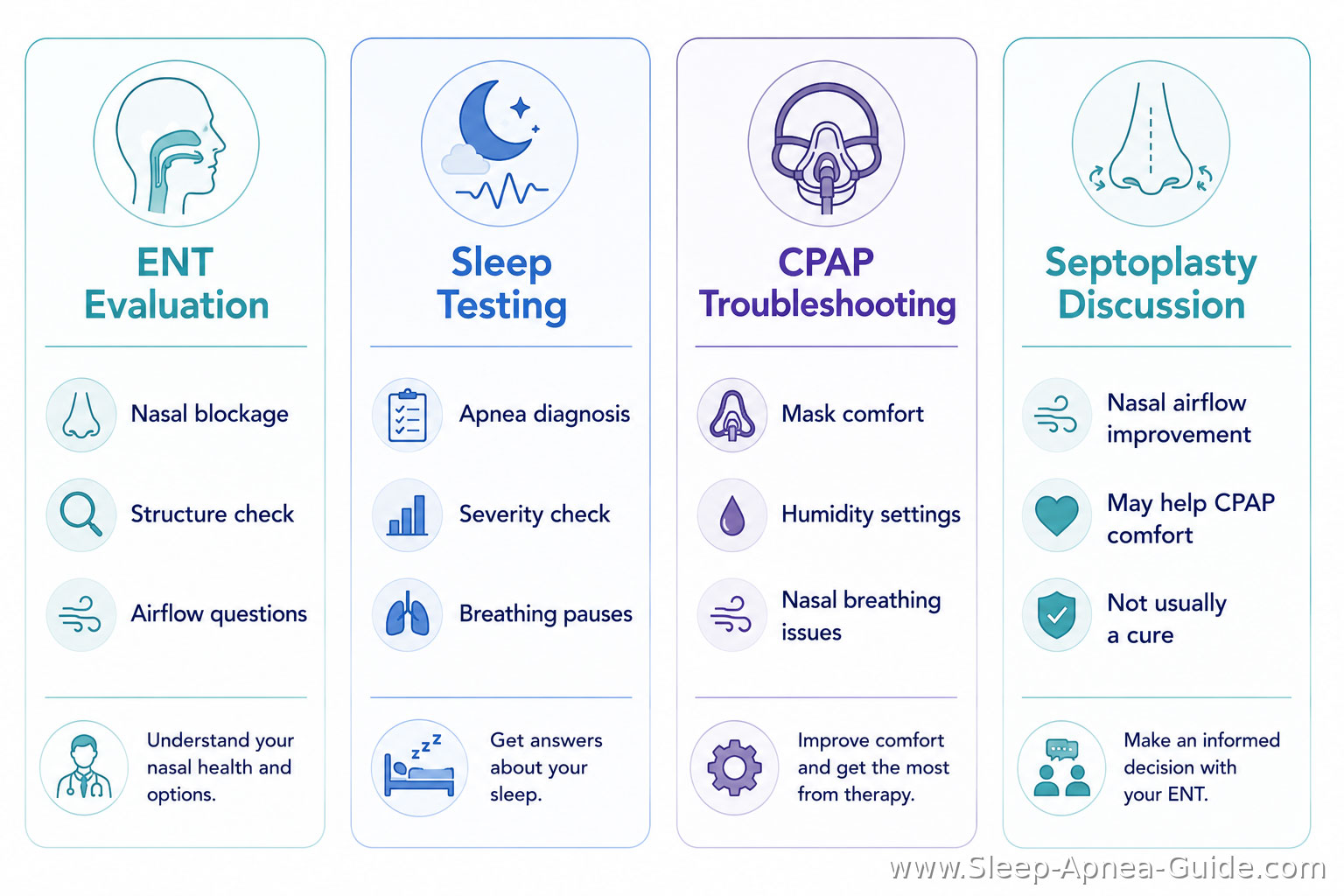
Use the pathways below to pick the next step based on what’s true for you right now.
Start with whichever has felt like the real problem lately:
Path 1: Sleep Testing
Start here if: You're snoring, your partner has noticed pauses or gasping, or you're dragging through the day — and you haven't had a formal sleep study yet.
What this step answers: Whether you actually have obstructive sleep apnea, and how severe it is.
What it doesn't answer: This measures your breathing, oxygen levels, and events overnight — it doesn't diagnose what's physically blocking your nose.
Sleep studies can identify whether obstructive sleep apnea is present and measure how severe it is — including breathing interruptions and changes in oxygen levels during sleep. [1] Warning signs that make sleep testing especially important include loud or habitual snoring, witnessed pauses in breathing, gasping or choking during sleep, daytime sleepiness, and morning headaches. [1][2]
Sources:
[1] National Heart, Lung, and Blood Institute (NHLBI). Sleep Apnea. https://www.nhlbi.nih.gov/health/sleep-apnea
[2] MedlinePlus. Sleep Apnea. https://medlineplus.gov/sleepapnea.html
What to do next (today):
- Talk to your doctor or a sleep specialist about getting tested — don't wait for symptoms to feel "bad enough."
- Ask whether a home sleep apnea test fits your situation, or whether an in-lab study is recommended.
- If nasal breathing is also a struggle, mention it — it can shape what's tested and treated.
Path 2: ENT Evaluation
Start here if: You're breathing through your mouth or waking up with a dry mouth most nights — even when you're not sick — and generally struggling to get air through your nose.
What this step answers: Whether something structural — a deviated septum, enlarged turbinates, or similar — is physically blocking your airflow.
What it doesn't answer: Whether you have obstructive sleep apnea, or how severe it is — a blocked nose and OSA are related, but neither one fully explains the other.
An ENT evaluation can confirm a deviated septum or other structural nasal finding by physical examination — but it doesn't measure apnea frequency, oxygen changes, or sleep-stage effects. Those require a sleep study. [1][2]
Sources:
[1]
National Institute on Deafness and Other Communication Disorders
(NIDCD). Deviated Septum.
https://www.nidcd.nih.gov/health/deviated-septum
[2] National Heart, Lung, and Blood Institute (NHLBI). Sleep Apnea. https://www.nhlbi.nih.gov/health/sleep-apnea
What to do next (today):
- Book an ENT evaluation, and mention your sleep symptoms or CPAP struggles too.
- Ask whether the blockage is structural (septum, turbinates) or from swelling/allergies.
- Ask what your options are if it is structural.
- If you also suspect sleep apnea, ask what this evaluation will improve — and what it won't.
Path 3: CPAP Troubleshooting
Start here if: You've been diagnosed with sleep apnea and CPAP feels physically miserable — not just inconvenient.
What this step answers: Why a blocked nose can make CPAP feel impossible.
What it doesn't answer: This step can improve comfort and help you stick with therapy — it doesn't diagnose what's blocking your nose, or decide whether you need an ENT visit or a septoplasty discussion.
CPAP trouble can reflect a nasal barrier, not a personal failure.
Nasal obstruction can make PAP therapy harder to tolerate, and in selected patients with documented nasal blockage, addressing that obstruction has been shown to improve comfort and use. [1] That said, nasal blockage is one possible reason for CPAP difficulty — not the only one. [1][2]
Sources:
[1] American Academy of Otolaryngology — Head and Neck Surgery (ENTnet).
Position Statement: Nasal Surgery and Obstructive Sleep Apnea Syndrome.
https://www.entnet.org/resource/position-statement-nasal-surgery-and-osas/
[2] Camacho M. et al. Systematic review: nasal surgery and OSA. PubMed Central. https://pmc.ncbi.nlm.nih.gov/articles/PMC9688553/
What to do next (today):
- Tell your sleep specialist or respiratory therapist (RT) exactly what's happening — whether that's struggling to exhale, pulling the mask off, or waking up with a dry mouth.
- Ask about pressure adjustments, heated humidity, or switching to a full-face mask.
Path 4: A Discussion About Septoplasty
Start here if: Nasal breathing feels blocked enough to affect your sleep or CPAP, and sprays, rinses, or CPAP humidity/mask changes haven't helped.
What this step may help: For some people, septoplasty makes daytime nasal breathing noticeably easier and CPAP more tolerable — less fighting the pressure, fewer leaks, less mouth breathing.
What it usually won't do: Septoplasty is not usually a cure for obstructive sleep apnea by itself — even if fixing your septum was the hope, most people still need CPAP or another OSA treatment afterward.
Most studies reviewed in a peer-reviewed systematic analysis did not find large or consistent reductions in apnea frequency after nasal surgery alone — and obstructive sleep apnea often involves airway collapse at multiple levels beyond the nose, which septoplasty doesn't address. [1][2]
Sources:
[1] Camacho M. et al. Systematic review: nasal surgery and OSA. PubMed
Central. https://pmc.ncbi.nlm.nih.gov/articles/PMC9688553/
[2] National Heart, Lung, and Blood Institute (NHLBI). Sleep Apnea. https://www.nhlbi.nih.gov/health/sleep-apnea
What to ask your ENT:
- Is my blockage structural, or could it improve without surgery?
- What realistically changes for my breathing and my CPAP use?
- What's the recovery, and when would I notice a difference?
Summary of Your Options
| Your current situation | Most sensible next step | What it answers or accomplishes |
|---|---|---|
| Snoring, tired, but undiagnosed | Sleep Testing | Determines if obstructive sleep apnea is present. |
| Constant trouble breathing through nose | ENT Evaluation | Identifies if anatomy (like a deviated septum) is blocking airflow. |
| Diagnosed, but CPAP feels suffocating | CPAP Troubleshooting | Adjusts equipment and masks to bypass or accommodate nasal blockage. |
| Confirmed blockage, CPAP adjustments failed | Septoplasty Discussion | Explores if surgery may improve nasal airflow and CPAP comfort. |
Common Myths About Deviated Septum and Sleep Apnea
Myth #1
Myth: Fixing your septum will automatically fix your sleep apnea.
Reality: A straighter septum may improve nasal airflow, snoring, and CPAP tolerance — but it usually doesn't cure obstructive sleep apnea or replace treatment.
A U.S. specialty-society position statement describes nasal surgery as a way to facilitate sleep apnea treatment — particularly CPAP use — rather than as a stand-alone cure. [1] Patients with sleep apnea symptoms still need sleep-apnea evaluation even if nasal surgery is being considered. [2]
Sources:
[1]
American Academy of Otolaryngology — Head and Neck Surgery (ENTnet).
Position Statement: Nasal Surgery and Obstructive Sleep Apnea Syndrome.
https://www.entnet.org/resource/position-statement-nasal-surgery-and-osas/
[2] National Heart, Lung, and Blood Institute (NHLBI). Sleep Apnea. https://www.nhlbi.nih.gov/health/sleep-apnea
What this changes (in real life): Breathing may feel lighter and CPAP may feel easier to use, but the apnea itself usually still needs its own treatment.
Next step:
- Haven't been diagnosed yet? Start with sleep testing.
- Already diagnosed, but nasal blockage or CPAP tolerance is the issue? Start with an ENT or septoplasty discussion.
Myth #2
Myth: Struggling with CPAP means you're not trying hard enough.
Reality: A deviated septum can significantly reduce nasal airflow, making standard nasal masks genuinely hard to tolerate. This is a mechanical issue, not a lack of willpower.
Research supports this: a peer-reviewed systematic review found that nasal surgery improved PAP-related tolerance in selected patients with documented nasal obstruction — suggesting that when the nose is genuinely the barrier, addressing it is a clinical step, not a workaround. [1]
Sources:
[1] Camacho M. et al. Systematic review: nasal surgery and OSA. PubMed Central. https://pmc.ncbi.nlm.nih.gov/articles/PMC9688553/
What this changes (in real life): Adjusting your treatment — a different mask, pressure settings, added humidity — for your anatomy is a standard, expected part of sleep medicine, not a sign you're doing something wrong.
Next step:
- Talk to your sleep specialist or respiratory therapist about pressure adjustments, humidity, or a different mask type.
Moving Forward With Confidence
Closing Reminder
- Fixing one problem doesn't automatically fix the other.
Fixing the nose improves the nose; treating sleep apnea protects your sleep and overall health.
You don't have to keep guessing — you have a clearer next step now. Choose the one that fits where you are today, and move forward with confidence.
You might like these
How Sleep Apnea Starts: Causes and Risks
See how sleep apnea risk factors stack together, what may be causing your breathing pauses, and when a sleep test becomes the sensible next step.
Why Do People Snore? | Sleep Apnea Guide
Does your partner have snoring problems? Click here to learn why do people snore, and you will also find how to stop your partner's snoring.
Sleep Apnea › Sleep Apnea Surgery › Deviated Septum
Affiliate Disclosure
As an Amazon Associate I earn from qualifying purchases.
Recent Articles


-
The Best CPAP Pillow For Sleep Apnea
Jul 22, 18 01:15 PM
 Why do you need a CPAP pillow, Which pillow is the best for CPAP users, and how to make one if you can't afford It.
 -
How To Use Portable Pulse Oximeter To Track Sleep Apnea Treatment?
Jul 09, 18 02:51 PM
 How can a portable pulse oximeter help with CPAP treatment? Can you trust a pulse oximeter to monitor sleep apnea? Click here to find the answers.
 -
The 3 Best Ways To Stop CPAP Dry Mouth
Jun 23, 18 11:02 AM
 How can you prevent and treat CPAP dry mouth? A practical guide to assist you with dry mouth when using the CPAP machine.
Subscribe
Don't worry - your e-mail address is totally secured. I promise to use it only to send you monthly updates with useful tips to improve you sleep apnea.


