Sleep Apnea Causes Overview: Cause vs Risk Factor vs Trigger/Worsener
According to the National Heart, Lung, and Blood Institute, sleep apnea is a condition in which breathing repeatedly stops or becomes shallow during sleep — and it can take more than one form.[1]
In obstructive sleep apnea, the airway narrows or collapses during sleep. Contributors can work in different ways.
- Some are underlying contributors — like anatomy or body patterns
- Some are risk factors that raise the odds, including inherited traits
- Some are triggers that make a given night worse
Sorting them can help reduce self-blame and clarify when it may be time to consider a sleep test or clinician review.
This page is meant to help you sort out what may be driving your symptoms and think about next steps — not to replace a clinical evaluation.
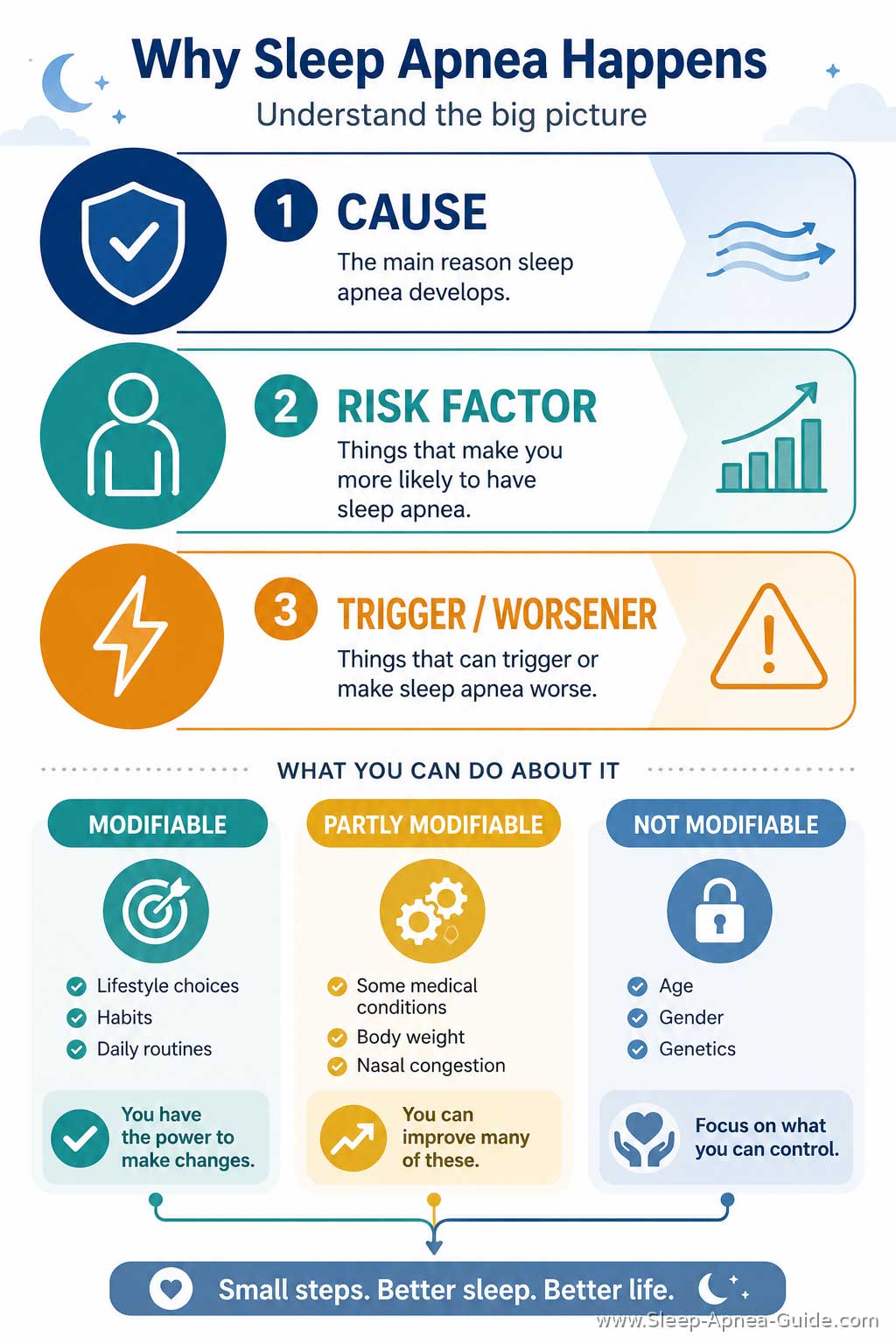
A better way to think about what's contributing to your sleep apnea
Some nights the snoring was worse, other nights it wasn't — and I couldn't point to anything I'd done differently. In college, a roommate woke me up because of it, and my first thought wasn't embarrassment — it was: am I making this worse somehow, or is this just how I'm built? That question is what got me to sort contributors instead of just collecting them, and made me seriously consider whether testing was the right next move.
What "cause," "risk factor," and "trigger/worsener" mean in plain English
To make sense of a sleep apnea causes overview, it helps to know how clinicians think. They usually look for patterns — mechanical patterns, family patterns, and life-stage patterns. Sorting your own patterns before making a list of worries helps you avoid bad next-step choices.
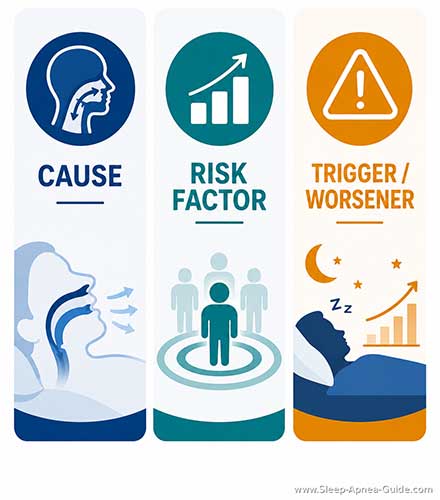
Cause - What's physically going wrong
- The actual mechanical root of the problem
- In obstructive sleep apnea, the cause is physical: your airway becomes too narrow or collapses while you sleep
Risk Factor - What puts you at higher risk
- A background trait that raises your odds of having that mechanical collapse
- It sets the stage — but it may not be what's making tonight worse
Trigger / Worsener - What makes it worse on a given night
- A specific, often temporary variable that makes the collapse happen more frequently or severely on any given night
- Often the most actionable starting point
Think of it this way: what you inherit from your family is a risk factor; how that inheritance shapes your airway is an underlying contributor.
Why mixing them up leads to bad next-step decisions
When we fail to separate the mechanical cause from a background risk or a nightly trigger, we can end up chasing the wrong solutions.
- Assuming weight is the single cause can lead to immense shame and may delay you from exploring a mechanical treatment that could help.
- Treating temporary nasal congestion as the main underlying contributor might lead you to buy endless nasal strips while ignoring a structural jaw issue.
Sorting contributors — even roughly — helps you choose what to trial first and recognize when it may be time to talk to a clinician.
Why more than one contributor can be true at the same time
Most people have more than one: It is incredibly common to have a narrow airway, a family history of snoring, and a habit of sleeping on your back. These contributors can combine and amplify the severity of your symptoms. Having multiple contributors is normal, expected, and absolutely not blameworthy.
What actually causes obstructive sleep apnea
The underlying mechanism: airway narrowing or collapse during sleep

At its core, obstructive sleep apnea is a physical, mechanical issue. When you fall asleep, the muscles in your body naturally relax. When obstructive sleep apnea occurs, the muscles in the back of the throat can relax so much that the tissue collapses inward, narrowing or completely blocking the airway. Your brain typically senses the drop in oxygen and briefly wakes you up to reopen the airway. Mayo Clinic describes this as the throat muscles relaxing during sleep until they narrow or close the airway — the immediate mechanical event that sets off the rest of the pattern.[2]
Why "the cause" is often a mechanical pattern, not one single life factor
Because the core issue is the collapse itself, certain structural patterns can make that collapse more likely. The shape of your jaw, the size of your tongue, and the natural width of your throat all dictate how much room air has to pass through. If your structural pattern leans toward a narrow airway, you have a mechanical tendency for collapse.
Physical traits that make your airway more likely to collapse
Certain physical traits make an airway more prone to closing during sleep:
A recessed or small lower jaw
Options that may help or are worth exploring:
- Mandibular advancement device (a mouthguard-style appliance that shifts the jaw forward during sleep) — available through a dentist specialising in sleep
- Orthodontic evaluation — in some cases bite correction can improve airway space
- Maxillomandibular advancement surgery — a more involved option for significant jaw structure issues, done by an oral and maxillofacial surgeon
- CPAP — works around the jaw issue rather than fixing it, but is often the first treatment recommended
Suggested note: "Worth raising with a dentist who specialises in sleep, or asking for an ENT or orthodontic referral."
A large tongue or crowded soft tissues in the throat
Options that may help or are worth exploring:
- Positional therapy — sleeping on your side reduces how much the tongue falls back
- Myofunctional therapy — exercises that strengthen the tongue and throat muscles, shown in some research to reduce severity
- CPAP — keeps the airway open regardless of tissue crowding
- Surgical options exist but are more involved and less commonly the first step
Suggested note: "A sleep specialist or ENT can assess whether tissue crowding is a primary driver and what options make sense."
Suggested note: "A sleep specialist or ENT can assess whether tissue crowding is a primary driver and what options make sense."
Naturally enlarged tonsils or adenoids
Options that may help or are worth exploring:
- Tonsillectomy — surgical removal, which can sometimes fully resolve sleep apnea when tonsils are the main blockage (the meta-analysis you already cite on the page supports this)
- ENT evaluation first to confirm tonsils are actually the primary issue before considering surgery
Suggested note: "An ENT evaluation can confirm whether tonsil size is the main driver — and if it is, removal can sometimes resolve the problem."
The National Heart, Lung, and Blood Institute notes that inherited changes in skull and face shape can reduce the amount of space in the upper airway, raising sleep apnea risk.[1]
See: [How jaw shape and bite issues contribute to sleep apnea]
Why weight matters — but doesn't explain everything
Body size is frequently discussed, but it is vital to frame it correctly. Fat distribution, particularly around the neck, can add physical weight and pressure to the outside of the airway, making it more likely to collapse when muscles relax. However, body size does not explain every case. In some cases, thin people can have severe sleep apnea due to jaw structure, and many larger people sleep perfectly fine.
Research from the Wisconsin Sleep Cohort found that a 10% weight gain predicted roughly a 32% increase in breathing event frequency during sleep — and a 10% weight loss predicted roughly a 26% decrease.[3]
Risk factors that raise your odds of sleep apnea
When looking at sleep apnea risk factors, remember that these traits raise your odds, but they are not necessarily the root mechanical cause.
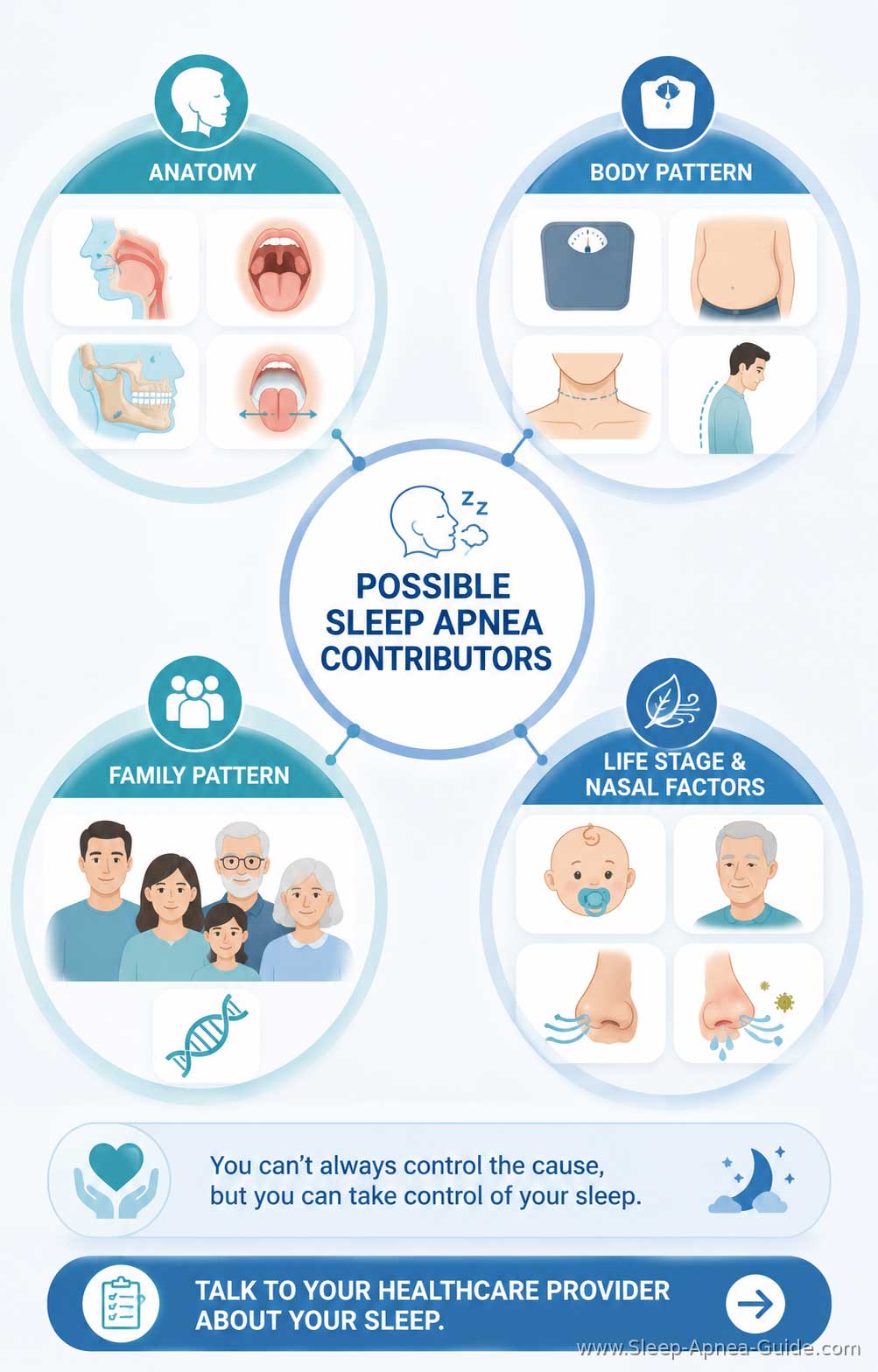
Body size, neck size, and fat distribution
As mentioned, tissue around the neck can increase airway crowding. While weight can be adjusted over time, genetics heavily dictate where your body stores fat, meaning neck size is not entirely in your control. Mayo Clinic explains this by pointing to fat deposits around the upper airway that can physically obstruct breathing — framing weight as one contributor among several, not the single cause.[2]
Family pattern and inherited anatomy
If your parents or grandparents snored heavily or used a CPAP, you are at a higher risk. You inherit your jaw shape, airway width, and muscle tone from your family. This risk factor is not really modifiable.
Age and sex-related patterns
As we age, we naturally lose muscle tone throughout the body, including in the throat. Additionally, men historically show higher rates of sleep apnea earlier in life than women. These age and sex-related patterns are not really modifiable.
Pregnancy and menopause as life-stage shifts
Hormonal changes and physical shifts during pregnancy can increase airway resistance. Later in life, the drop in estrogen and progesterone during menopause changes muscle tone and fat distribution, significantly raising a woman's risk. A community-based study of 1,000 women found sleep-disordered breathing in 0.6% of premenopausal women, rising to 5.5% in postmenopausal women not using hormone therapy — a difference that held after adjusting for age, body weight, and smoking.[4] These life-stage shifts are not really modifiable.
See: [Women-specific life stages: pregnancy + menopause drivers]
Nasal congestion and blocked breathing
If you cannot breathe easily through your nose due to a deviated septum or chronic allergies, this can increase negative pressure in your throat and contribute to airway collapse.
Mayo Clinic lists persistent nasal congestion as a risk factor for obstructive sleep apnea, and notes that difficulty breathing through the nose — whether from an anatomical issue or allergies — is associated with a higher likelihood of obstructive events.[2] This is partly modifiable through allergy management or ENT evaluation.
See: [How nasal obstruction contributes to obstructive sleep apnea]
Triggers: what makes sleep apnea worse on a given night
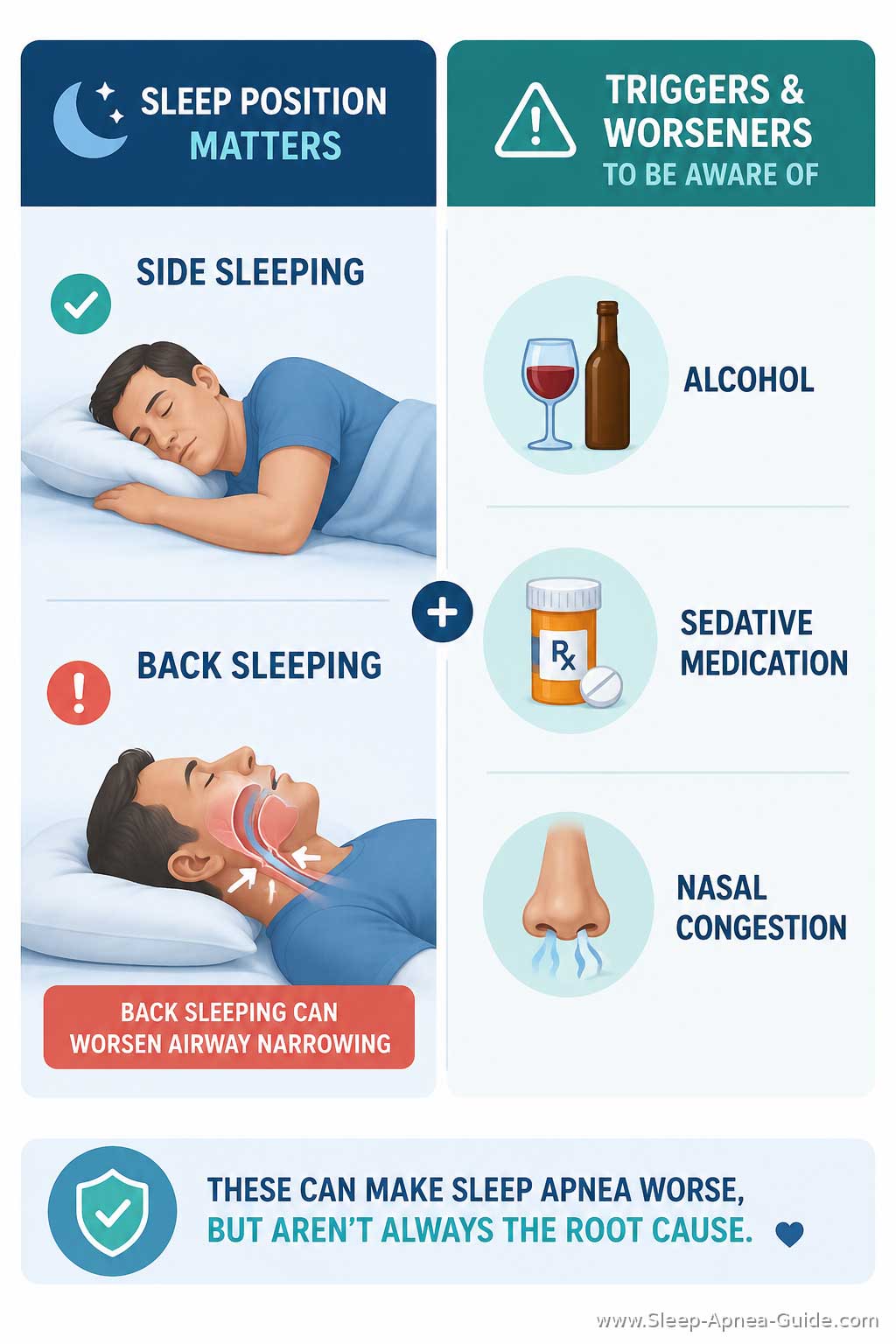
Triggers change how often or how severely your airway collapses on a specific night, but they may not be the underlying contributor. Because they are often in your control, it is usually worth trialing one simple change for a few nights before moving on to more complex options.
On nights when I ended up on my back, I'd wake up coughing or jolting awake. On nights when I stayed on my side — propped with a wedge pillow to stop me rolling over — I slept through more of the night without that kind of awakening. That pattern was enough to make me try positional changes as a first, before considering anything more complex.
Sleeping on your back and positional worsening
Gravity pulls the tongue and soft palate down toward the back of the throat when you sleep flat on your back. For many, this is a major worsener.
Research suggests that around 56% of people with obstructive sleep apnea may meet criteria for positional sleep apnea — meaning their breathing events are at least twice as frequent when lying on their back compared to lying on their side.[5]
A quick action to try is sleeping on your side using any positional support that keeps you on your side. Try it for a few nights in a row — if you're still jolting awake or still feeling exhausted in the morning, that's a reasonable threshold for a clinician conversation.
See: [Why sleep apnea gets worse on your back (positional sleep apnea)]
Alcohol, sleeping pills, opioids, and muscle-relaxing effects
Substances that relax the central nervous system also relax the throat muscles more than normal sleep does. This makes collapse much more likely. Limiting alcohol before bed is a quick action to try.
Mayo Clinic confirms that alcohol and sedatives can worsen obstructive sleep apnea specifically because they relax the muscles in the back of the throat.[2]
If you take prescribed sedatives or opioids, never stop them abruptly; this requires a medication review with your clinician.
See: [Can medications worsen sleep apnea, and why?]
Short-term congestion, illness, and sleep disruption
When you're congested, it can be harder to breathe through your nose, so you may mouth-breathe more during sleep. For me, that tends to show up as worse snoring or more awakenings than usual the next morning. Saline rinses or a humidifier are low-risk things to try first; if you're considering any medication for congestion, it's worth checking with a clinician or pharmacist before using it regularly.
If congestion is the only time your symptoms spike, that may be a useful signal worth noting — it could point toward a temporary worsener rather than a deeper pattern, though sorting that out fully is worth discussing with a clinician.
Some things you can change tonight — others run deeper
Improving one bad night and addressing the deeper pattern are two different things — and knowing that distinction can save you a lot of frustration. For someone whose underlying contributor may be anatomy — a small jaw, for example — skipping a glass of wine might make sleep slightly better on a given night, but it may not address the deeper pattern.
What you can change, what you can partly change, and what you can't — and why it matters
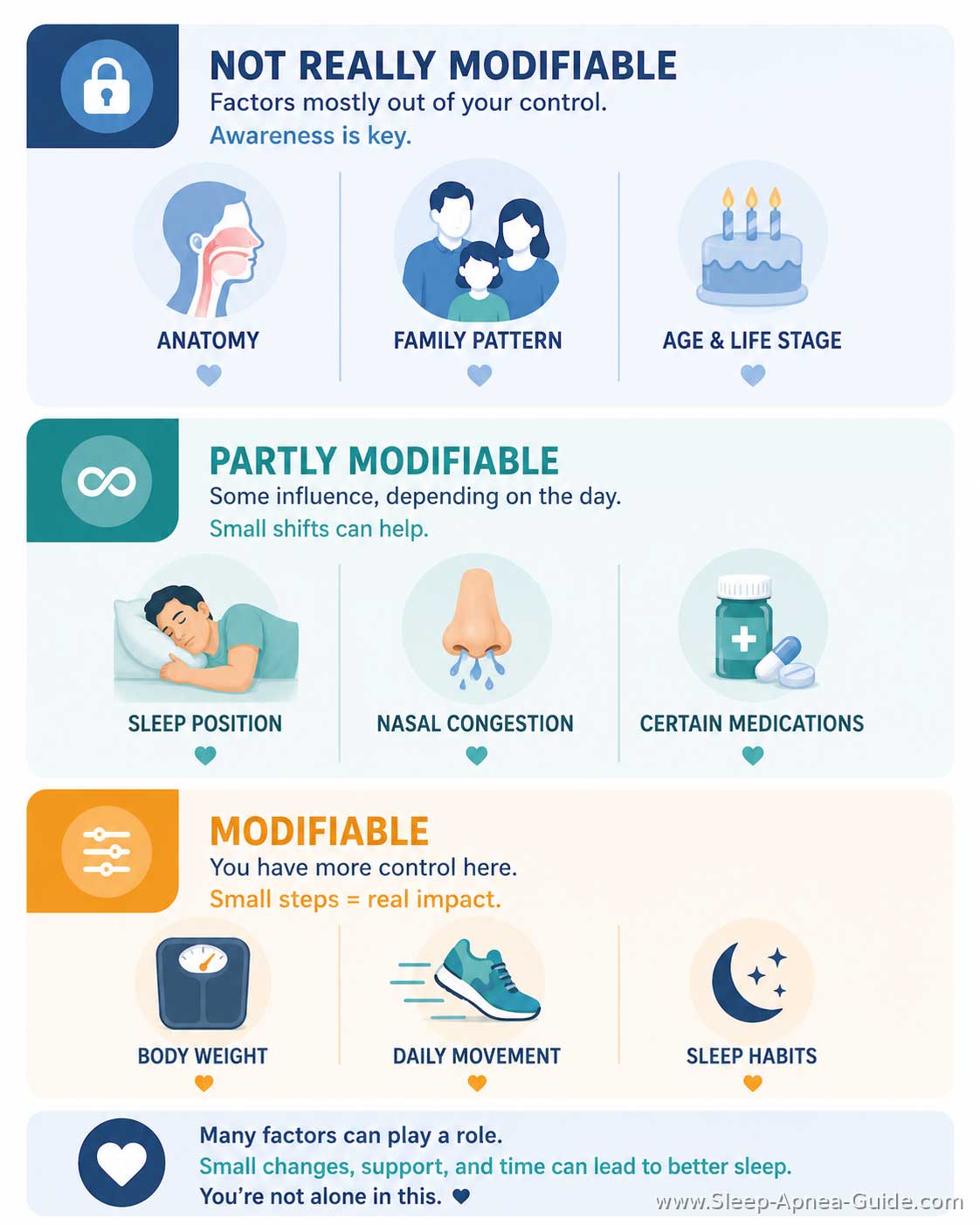
Mapping out what you can and cannot change provides calm, practical next steps instead of endless worry.
After a bad night, my first move was grabbing my phone and searching — which mostly made things worse. What actually helped was putting it on paper: things I could try tonight, things that are just how I'm built, and whether to keep trying things myself or consider a sleep test. Separating those three columns was the moment the overwhelm started to lift — and starting with what I couldn't change turned out to be the most relieving place to begin.
Not really modifiable: inherited anatomy, family pattern, some life-stage realities
You cannot change your genetics, your age, or the natural shifts of menopause. Recognizing this helps you let go of the stress of trying to "fix" things outside your control.
Partly modifiable: weight-related contribution, congestion management, sleeping position
You can often improve chronic congestion, train yourself to sleep on your side, and work on gradual health habits. These take time and effort but can yield noticeable improvements.
Modifiable triggers: alcohol timing, medication review with a clinician, evening habits
You have high control over these nightly variables. Adjusting when you have a drink or talking to your doctor about your sleep medication are highly actionable steps.
Why "modifiable" does not mean "your fault"
Even if a contributor is labeled "modifiable," it does not mean this situation is a personal failure. Modern life, stress, and biology are complex. The goal of labeling something modifiable is to give you power over your next steps, not to assign blame.
How to make a simple shortlist of your most likely contributors
Here is a simple contributor matrix to help you sort your thoughts:
| Contributor | Category | Modifiability |
|---|---|---|
| Jaw shape / narrow airway | Deeper cause | partly in your control |
| Family history | Risk factor | outside your control |
| Menopause / Age | Risk factor | outside your control |
| Back-sleeping | Nightly trigger | you can change this |
| Evening alcohol | Nightly trigger | you can change this |
To build your shortlist:
- Note your patterns: Do you only snore on your back, or do you jolt awake every night regardless of position?
- Note what's in your control: Highlight the triggers you can safely test changing this week (like sleeping on your side).
- Decide on testing: If you adjust the changeable triggers and still feel exhausted or notice breathing pauses, that is a reasonable signal to seek a sleep test.
When central sleep apnea might be part of what's going on
How central sleep apnea differs from obstructive sleep apnea

While obstructive sleep apnea is a mechanical blockage, central sleep apnea is a communication failure. The airway remains open, but the brain temporarily fails to send the signal to the breathing muscles to take a breath.
Who is more likely to have central sleep apnea
Central sleep apnea is less common. It is more likely to appear in individuals with a history of heart failure, stroke, certain neurological conditions, or those who use prescription opioid pain medications long-term.
A review of eight studies found that central sleep apnea was present in roughly 24% of people on chronic opioid therapy — supporting the point that long-term opioid use is one of the more significant factors associated with central rather than obstructive patterns.[6]
Why this matters for testing and follow-up
If you have risk factors associated with central sleep apnea based on your medical history, standard obstructive treatments (like basic mouthguards) may not address the underlying issue. This lowers your testing threshold: consider moving past simple home trials and mentioning this directly to a sleep specialist.
See: [What causes central sleep apnea?]
FAQ: Specific questions about sleep apnea causes
This section covers more specific questions you might still have after reading the page above.
What's the difference between obstructive sleep apnea and central sleep apnea causes?
What's the difference between obstructive sleep apnea and central sleep apnea causes?
Obstructive sleep apnea is caused by a physical, mechanical narrowing or collapse of the airway tissues during sleep. Think of it as a plumbing problem.
Central sleep apnea is caused by the brain failing to send the proper electrical signals to the breathing muscles. Think of it as an electrical or signalling problem, often linked to heart or neurological conditions.
Is snoring a cause of sleep apnea or a symptom of it?
Is snoring a cause of sleep apnea or a symptom of it?
Snoring is a symptom, not a cause. It is the sound made by turbulent air forcing its way through a narrowed airway. Not everyone who snores has sleep apnea, but loud, disruptive snoring paired with silent pauses or gasping is the kind of pattern that may warrant a clinician conversation or sleep test.
Can sleep apnea be caused by weight gain, and can weight loss reverse it?
Can sleep apnea be caused by weight gain, and can weight loss reverse it?
Weight gain can be a significant risk factor because extra tissue around the neck physically weighs down the airway. For some people, this pushes a slightly narrow airway into full collapse.
Weight loss can reduce the severity of sleep apnea and, in some specific cases, may resolve it. However, because underlying jaw structure and anatomy play such a significant role, weight loss is not a guaranteed cure for everyone.
Can large tonsils cause sleep apnea in adults?
Can large tonsils cause sleep apnea in adults?
Yes. While enlarged tonsils and adenoids are the most common cause of sleep apnea in children, adults can also have naturally large tonsils that crowd the back of the throat. If an ENT doctor determines your tonsils are the primary mechanical blockage, removing them can sometimes resolve the apnea.
A meta-analysis of 17 studies in adults with obstructive sleep apnea and enlarged tonsils found that tonsillectomy reduced average breathing event frequency from around 40 events per hour to around 14 events per hour, with an 85% surgical success rate in that group.[7]
Can allergies or nasal congestion cause sleep apnea, or mostly make it worse?
Can allergies or nasal congestion cause sleep apnea, or mostly make it worse?
Chronic nasal congestion can act as both a risk factor and a powerful worsener. When your nose is blocked, you breathe through your mouth. Mouth-breathing alters the position of your jaw and tongue, pushing them backward and narrowing the airway.
While allergies alone may not be the sole underlying contributor if you have a perfectly wide airway, they can easily push someone with a borderline airway into active sleep apnea.
Can alcohol make sleep apnea worse?
Can alcohol make sleep apnea worse?
Yes, alcohol is a potent worsener. It acts as a muscle relaxant, which means the muscles in the back of your throat become slacker than they normally would during sleep. This makes the airway much more prone to collapsing, often turning a quiet sleeper into a heavy snorer for the night.
Can sleeping pills or sedatives worsen sleep apnea?
Can sleeping pills or sedatives worsen sleep apnea?
Yes. Similar to alcohol, many traditional sleeping pills, sedatives, and muscle relaxants depress the central nervous system. They relax the airway muscles and can also blunt the brain's ability to wake you up quickly when oxygen levels drop. Always review medications with your doctor if you suspect sleep apnea.
Can sleep apnea run in families?
Can sleep apnea run in families?
Absolutely. You inherit your physical anatomy from your family, including the size of your jaw, the shape of your palate, and the width of your airway. If sleep apnea runs in your family, your baseline risk is higher due to these shared structural patterns.
Can menopause increase sleep apnea risk?
Can menopause increase sleep apnea risk?
Yes. Before menopause, female hormones like progesterone and estrogen help maintain airway muscle tone. When these hormone levels drop during menopause, the airway becomes more collapsible. Fat distribution also tends to shift upward toward the neck and torso, further increasing risk.
A community-based study of 1,000 women found sleep-disordered breathing in 0.6% of premenopausal women, rising to 5.5% in postmenopausal women not using hormone therapy — a gap that persisted even after accounting for age, body weight, and smoking.[4]
Can pregnancy cause or worsen sleep apnea?
Can pregnancy cause or worsen sleep apnea?
Pregnancy can both trigger temporary sleep apnea and worsen existing cases. Hormonal changes cause mucous membranes to swell, leading to nasal congestion. Additionally, the physical weight of the growing baby pushes upward on the diaphragm, reducing lung volume and oxygen reserves during sleep.
Why is sleep apnea often worse when sleeping on your back?
Why is sleep apnea often worse when sleeping on your back?
When you sleep flat on your back, gravity works against you. It pulls the base of your tongue and your soft palate directly down into the back of your throat. For many people, simply shifting to their side removes this gravitational pull and significantly reduces airway collapse.
Next steps
Now that you have a better grasp of your potential contributors, you have two clear paths forward.
Trial window
If your sleep feels inconsistent — or you suspect something specific is making certain nights worse — give yourself a few nights to test the low-effort levers covered on this page: sleeping on your side, managing evening congestion with saline, and limiting alcohol before bed.
Note what changes and what doesn't.
Testing conversation
If you are jolting awake or gasping at night, experience severe daytime fatigue, have a bed partner who notices you stop breathing, or have certain heart conditions in your history, these are reasonable signals to move past home trials and talk to a clinician about whether a sleep study makes sense.
When in doubt, ask your clinician before trialing on your own.
Having multiple contributors is normal — and none of this is your fault.
Sources
- [1] National Heart, Lung, and Blood Institute. Sleep Apnea. https://www.nhlbi.nih.gov/health/sleep-apnea
- [2] Mayo Clinic. Sleep Apnea — Symptoms and Causes. https://www.mayoclinic.org/diseases-conditions/sleep-apnea/symptoms-causes/syc-20377631
- [3] Peppard PE, Young T, Palta M, Dempsey J, Skatrud J. (2000). Longitudinal study of moderate weight change and sleep-disordered breathing. JAMA. https://pubmed.ncbi.nlm.nih.gov/11122588/
- [4] Bixler EO, Vgontzas AN, Lin HM, Ten Have T, Rein J, Vela-Bueno A, Kales A. (2001). Prevalence of sleep-disordered breathing in women: effects of gender. American Journal of Respiratory and Critical Care Medicine. https://pubmed.ncbi.nlm.nih.gov/11254512/
- [5] Positional obstructive sleep apnea review. PMC. https://pmc.ncbi.nlm.nih.gov/articles/PMC3575552/
- [6] Correa D, Farney RJ, Chung F, Prasad A, Lam D, Wong J. (2015). Chronic opioid use and central sleep apnea: a review of the prevalence, mechanisms, and perioperative considerations. Anesthesia & Analgesia. https://pmc.ncbi.nlm.nih.gov/articles/PMC3459206/
- [7] Camacho M, Teixeira J, Abdullatif J, Acevedo JL, Certal V, Capasso R, Kushida CA. (2016). Tonsillectomy for obstructive sleep apnea in adults: systematic review and meta-analysis. Otolaryngology–Head and Neck Surgery. https://pubmed.ncbi.nlm.nih.gov/27005314/
Affiliate Disclosure
As an Amazon Associate I earn from qualifying purchases.
Recent Articles


-
The Best CPAP Pillow For Sleep Apnea
Jul 22, 18 01:15 PM
 Why do you need a CPAP pillow, Which pillow is the best for CPAP users, and how to make one if you can't afford It.
 -
How To Use Portable Pulse Oximeter To Track Sleep Apnea Treatment?
Jul 09, 18 02:51 PM
 How can a portable pulse oximeter help with CPAP treatment? Can you trust a pulse oximeter to monitor sleep apnea? Click here to find the answers.
 -
The 3 Best Ways To Stop CPAP Dry Mouth
Jun 23, 18 11:02 AM
 How can you prevent and treat CPAP dry mouth? A practical guide to assist you with dry mouth when using the CPAP machine.
Subscribe
Don't worry - your e-mail address is totally secured. I promise to use it only to send you monthly updates with useful tips to improve you sleep apnea.


