Oropharyngeal Exercises
Mouth and Neck Exercises That Can Help Improve Sleep Apnea
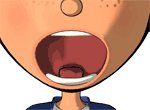
In this article you will discover 21 oropharyngeal exercises that can help you improve severe snoring and even obstructive sleep apnea (OSA).
These exercises are useful for sleep breathing disorders only if the cause is similar with snoring. That is: large neck with weak muscles and floppy tissue.
Your challenge is to strengthen these weak muscles to prevent them collapsing during sleep. Moreover, if you are overweight, you can get faster results by losing weight.
Are Oropharyngeal Exercises Effective?
Because the best therapy - CPAP - is not tolerated by many patients, and surgery or dental appliances can also bring side effects, scientists are interested to review the alternative methods and study them more carefully.
You can read their opinion about unconventional therapy for sleep apnea here.
Studies That Prove the Efficiency of Mouth & Neck Exercises
A Brazilian study shows that doing certain tongue and facial exercises for 30 minutes daily may ease the severity of obstructive sleep apnea.
Those exercises for sleep apnea included:
- brushing the tongue with a toothbrush,
- putting the tip of the tongue on the soft palate and sliding the tongue backward,
- pronouncing vowels quickly or continuously,
- keeping the tongue in a certain position when eating,
- and other methods.
This short video demonstrates some of the oropharyngeal exercises practiced in the study:
This study included thirty-one adults with moderate obstructive sleep apnea.
The results of the study was interesting: after three months of oropharyngeal exercises, the patients had reduced their obstructive sleep apnea severity by thirty-nine percent.
They also reported that they were snoring less, sleeping better, and less sleepiness during daytime.
Larger studies are needed to confirm the results and to learn which oropharyngeal exercises were most important, but the basic idea is to strengthen the muscles around the airway so it's less likely to collapse during sleep, say the researchers, who included Katia Guimaraes of the sleep laboratory at Brazil's University of Sao Paolo Medical School.
How the Oropharyngeal Exercises Were Invented?
Training the airway muscle to significantly improve OSA was previously done with the use of a singing instrument - the didgeridoo. To have a more accessible method to strengthen your airway, the oropharyngeal exercises were developed, which are derived from speech therapy.
These exercises include a variety of movements which will train your soft palate, tongue and facial muscles. They are best performed with an instructor (speech pathologist), to receive valuable information related to your performance.
How Should You Practice the Exercises?
Although there are included exercises for the soft palate, tongue, facial muscles and mouth, most of them need to be practiced daily, for 3 minutes.
Practicing all the 21 exercises bellow will result in a total of 63 minutes. However, for your convenience or for not having enough time, choose only half of these exercises to practice 30 minutes per day in one month, then use the other half for the next month, and so on.
Remember that in the brazilian clinical study, 3 months of exercise reduced the severity of sleep apnea by 39%, evaluation determined by the polysomnogram.
A huge disadvantage of these oropharyngeal exercises is the need to continuously practice every day, for many years or the sleep apnea symptoms may return.
However, knowing that you will sacrifice only 30 minutes per day so that you can improve your OSA, without spending money for expensive devices that you can't tolerate, it doesn't sound so bad.
Just remember to test your improvements every 3 months at home or in a sleep clinic. It's very dangerous to believe your sleep apnea is cured, only to fall asleep at the wheel and have a car accident.
21 Oropharyngeal Exercises for OSA
Here are the most common oropharyngeal exercises for obstructive sleep apnea and snoring:
Exercise 1
Slowly open and close your mouth to its full extent, making sure the lips meet when closing.
Exercise 2
Pucker your lips (as if about to kiss). Hold for a count of 10.
Relax.
Exercise 3
Spread your lips into a big, exaggerated smile.
Hold. Relax.
Exercise 4
Mix Exercises 2 & 3: Pucker-Hold-Smile-Hold.
Exercise 5
Try to pucker with your mouth wide open, without closing your jaws together. Hold & relax.
Exercise 6
Close your lips and press them tightly together.
Exercise 7
Close your lips firmly, then make a "slurping" noise, as if sipping a drink.
Exercise 8
Open your mouth and stick out your tongue. Be sure your tongue comes straight out of your mouth and doesn't go off the side.
Hold, relax and repeat several times.
Work toward sticking your tongue out farther each day, but still pointing straight ahead.
Exercise 9
Stick out your tongue and try to reach your chin with the tongue tip. Hold at the farthest extension.
Exercise 10
touch your nose with the tongue tip. Hold at farthest extension.
Exercise 11
Stick out your tongue. Hold a spoon upright against the tip of your extended tongue and try to push it away while your hand holds the spoon in place.
Exercise 12
Repeatedly stick your tongue in and out as fast as you can.
Exercise 13
Flick your tongue from corner to corner as quickly as you can.
Exercise 14
Move tongue all around your lips in a circle as quickly as you can, making sure you stay in constant contact.
Exercise 15
Open and close mouth as quickly as you can, making sure your lips close each time.
Exercise 16
Say "Ma-Ma-Ma-Ma" as quickly as possible, ensuring there's an "em" and an "ah" sound each time.
Exercise 17
Repeat with "La-La-La-La."
Exercise 18
Repeat with "Ka-Ka-Ka-Ka" as quickly and accurately as you can.
Exercise 19
Repeat with "Kala-Kala-Kala-Kala"
Exercise 20
Gargle loudly with warm water.
Exercise 21
Sing through the vowel sounds (A-E-I-O-U) as loudly as you can (or dare). Songs like "Old McDonald Had a Farm" are also good.
Adapted from: many websites that teach how to improve speach performance. You can find these exercises scattered online. You just need time to find them all.
Although some patients with sleep apnea have success with oropharyngeal exercises, the results are not consistent enough to be formally recommended.
If you are interested in improving your snoring and sleep apnea with these exercises, you need consistency and dedication. It can't hurt to try.
Please don't give up if you don't improve earlier than 3 months.
Some more great pages you might like:
Home › Cures for Sleep Apnea › Oropharyngeal Exercises
Affiliate Disclosure
As an Amazon Associate I earn from qualifying purchases.
Recent Articles


-
The Best CPAP Pillow For Sleep Apnea
Jul 22, 18 01:15 PM
 Why do you need a CPAP pillow, Which pillow is the best for CPAP users, and how to make one if you can't afford It.
 -
How To Use Portable Pulse Oximeter To Track Sleep Apnea Treatment?
Jul 09, 18 02:51 PM
 How can a portable pulse oximeter help with CPAP treatment? Can you trust a pulse oximeter to monitor sleep apnea? Click here to find the answers.
 -
The 3 Best Ways To Stop CPAP Dry Mouth
Jun 23, 18 11:02 AM
 How can you prevent and treat CPAP dry mouth? A practical guide to assist you with dry mouth when using the CPAP machine.
Subscribe
Don't worry - your e-mail address is totally secured. I promise to use it only to send you monthly updates with useful tips to improve you sleep apnea.